

A smoked salvia trip starts within a minute, is at its strongest around the second minute and is mostly over within 15 to 20 minutes. Chewed leaves work more slowly: the effect builds over 5 to 20 minutes and can last up to two hours. Between those clock times, people describe a sequence that is remarkably consistent from report to report, even though the content of each trip is not.
The italic fragments on this page are composites. They are written from patterns that recur in published experience reports and in the participant descriptions of laboratory studies, and they do not describe one real person.
The clock at a glance
| Phase | Smoked or vaporised extract | Chewed leaf |
|---|---|---|
| First effects | Within 60 seconds, often within 30 | 5 to 20 minutes |
| Strongest point | About 2 minutes | Builds slowly, no sharp peak |
| Main effect over | 15 to 20 minutes | 30 minutes to 2 hours |
| After-effects | 15 to 60 minutes | 30 to 120 minutes |
Sources: Alcohol and Drug Foundation (updated 18 September 2026), FRANK, and the laboratory studies below. In a survey of 500 people who smoked salvia, the main effect lasted 14 minutes on average, with answers from half a minute to two hours (Baggott et al., 2010).
0:00 to 0:30, the inhale
Salvinorin A, the active substance, is absorbed through the lungs within seconds. In a Barcelona study, the level in the blood was highest one to two minutes after a vaporised dose (Maqueda et al., 2016). Many reports describe the first change before the smoke has been exhaled: sound goes flat or distant, and the room seems to tilt a little.
The lighter is still in my hand. The room sounds as if someone has laid a sheet over it.
0:30 to 1:00, onset
Researchers who studied 34 uncut videos of people smoking salvia found the first effects often appeared in less than 30 seconds (Lange et al., 2010). Participants in a placebo-controlled study said the same thing in their own words: "The effects started in the first instant after inhalation" and "During the first minute, the effects increased very fast" (Maqueda et al., 2015).
This is where the typical salvia themes start: a pull or pressure on one side of the body, the visual field splitting into panels or layers, the sense that the room is moving while you stay still. The themes page goes through each of them.
The edge of the sofa slides to the left, slowly, and takes the light with it.
1:00 to 5:00, the peak
In the Johns Hopkins studies, drug strength ratings were highest at the first measurement, two minutes after inhaling, and at high doses volunteers often gave the maximum rating or stopped responding at all (Johnson et al., 2011; MacLean et al., 2013). The Barcelona team measured a strong reduction in perception of the outside world at the highest dose (Maqueda et al., 2015).
From the outside, this is the phase in which people sit very still or, in other settings, talk, laugh and move more than usual (Addy, 2012). From the inside, reports describe being somewhere else entirely: inside a surface, part of an object, in a place that feels familiar. The ordinary room is often gone.
There is no room. There is a surface, and I am folded into it with the other parts.
5:00 to 10:00, loosening
The layers start to slide back. In the video study, effects tended to fade within eight minutes (Lange et al., 2010). Reports often place the laughter here: a release that is out of proportion to anything funny. The body comes back in pieces, and so does the meaning of what is in the room.
The planes slide back. I laugh, much too loud for the joke, because there was no joke.
10:00 to 20:00, return
By about twenty minutes, definite effects were no longer present in the Johns Hopkins study (Johnson et al., 2011), and the Barcelona team saw intensity drop back to baseline over the same period (Maqueda et al., 2015). One participant described the end as work: "It cost me some efforts to bring my mind back to my body."
Hands first. Then the word for hands. The sitter is still on the chair, which feels like an achievement.
The hour after
After a smoked trip, after-effects usually fade within 15 to 60 minutes (ADF). People describe a quiet, slightly dazed state and a strong urge to tell someone what happened, combined with difficulty doing so. Recall and recognition were measurably weaker for what happened during the effect (MacLean et al., 2013), which is why many reports have a clear beginning and end and a hazy middle.
Ten minutes, the clock says. I have a whole story and can only find its first and last page.
Chewed leaves, a slower curve
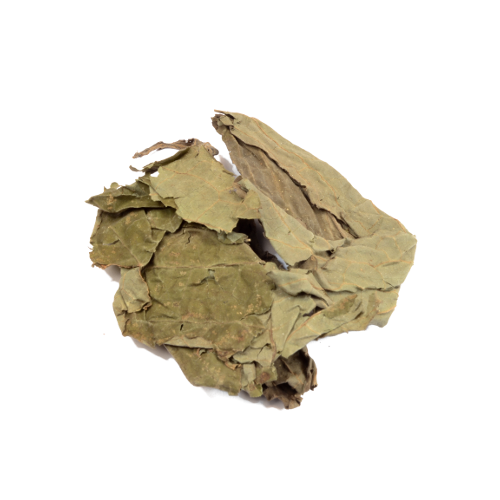
Holding a wad of leaves in the mouth (a quid) gives a different shape. UK government information puts the start at 5 to 10 minutes and the duration at up to two hours (FRANK). The effect builds gradually and there is time to notice it coming, which is the main difference people describe between a quid and a pipe. The composite reports by strength include a leaf quid next to smoked extracts.
Why the clock feels wrong
Almost every report says the trip felt longer than the clock shows, or that time stopped counting at all. FRANK mentions dramatic time distortion at higher doses. One participant in Barcelona put it well: "the temporal axis was creased like an accordion" (Maqueda et al., 2015). A sitter with a watch is the only reliable clock in the room; see difficult trips for what sitters do.
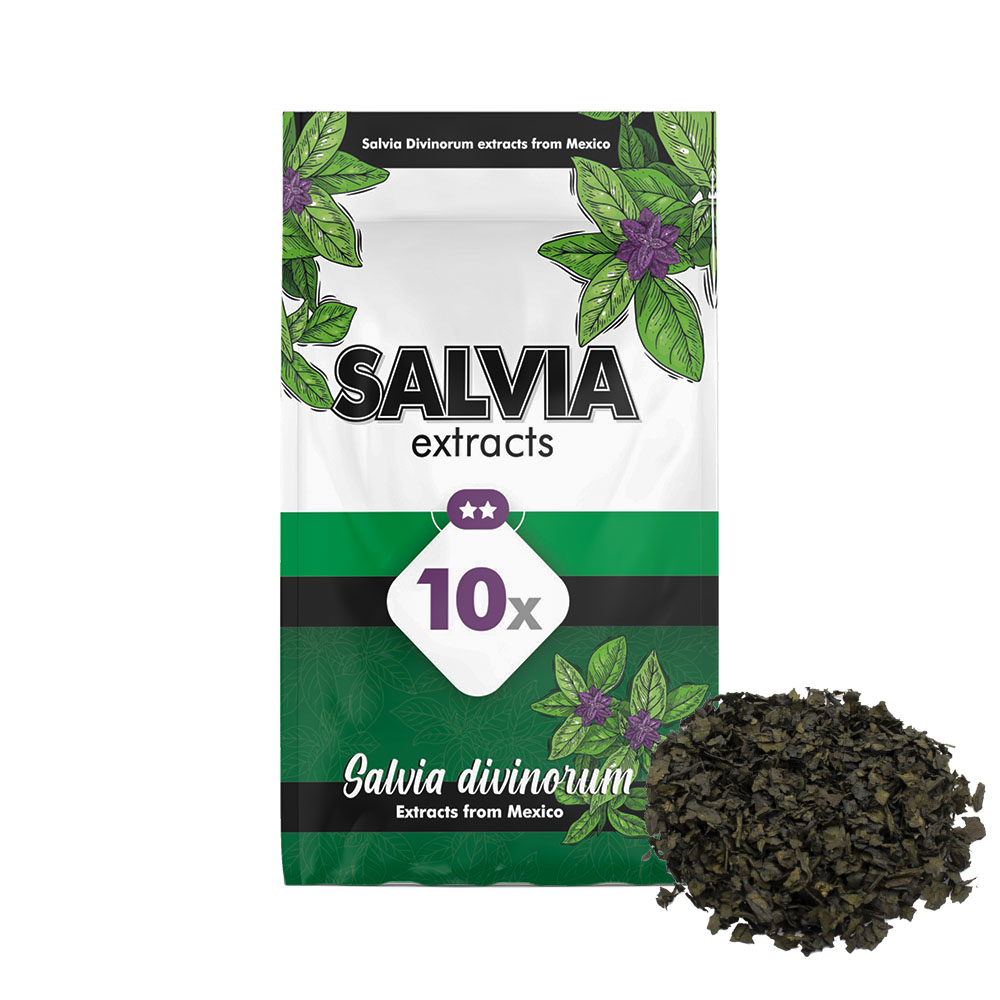
The extract strength mainly changes how far the peak goes, much less how long it lasts. The strength guide compares leaves and extracts as the shop describes them.
 Avalon Magic Plants
Salvia Divinorum Leaves
€4.90 View in the shop
Avalon Magic Plants
Salvia Divinorum Leaves
€4.90 View in the shop
 Avalon Magic Plants
Salvia Divinorum 10X extract
€14.50 View in the shop
Avalon Magic Plants
Salvia Divinorum 10X extract
€14.50 View in the shop
Updated